When Your Clearinghouse Goes Down: A Claims Contingency Plan for Medical Practices
What to do when your medical billing clearinghouse goes down: a claims contingency plan to keep claims moving, protect cash flow, and recover fast.
By MBT Editorial Team · Published October 28, 2026
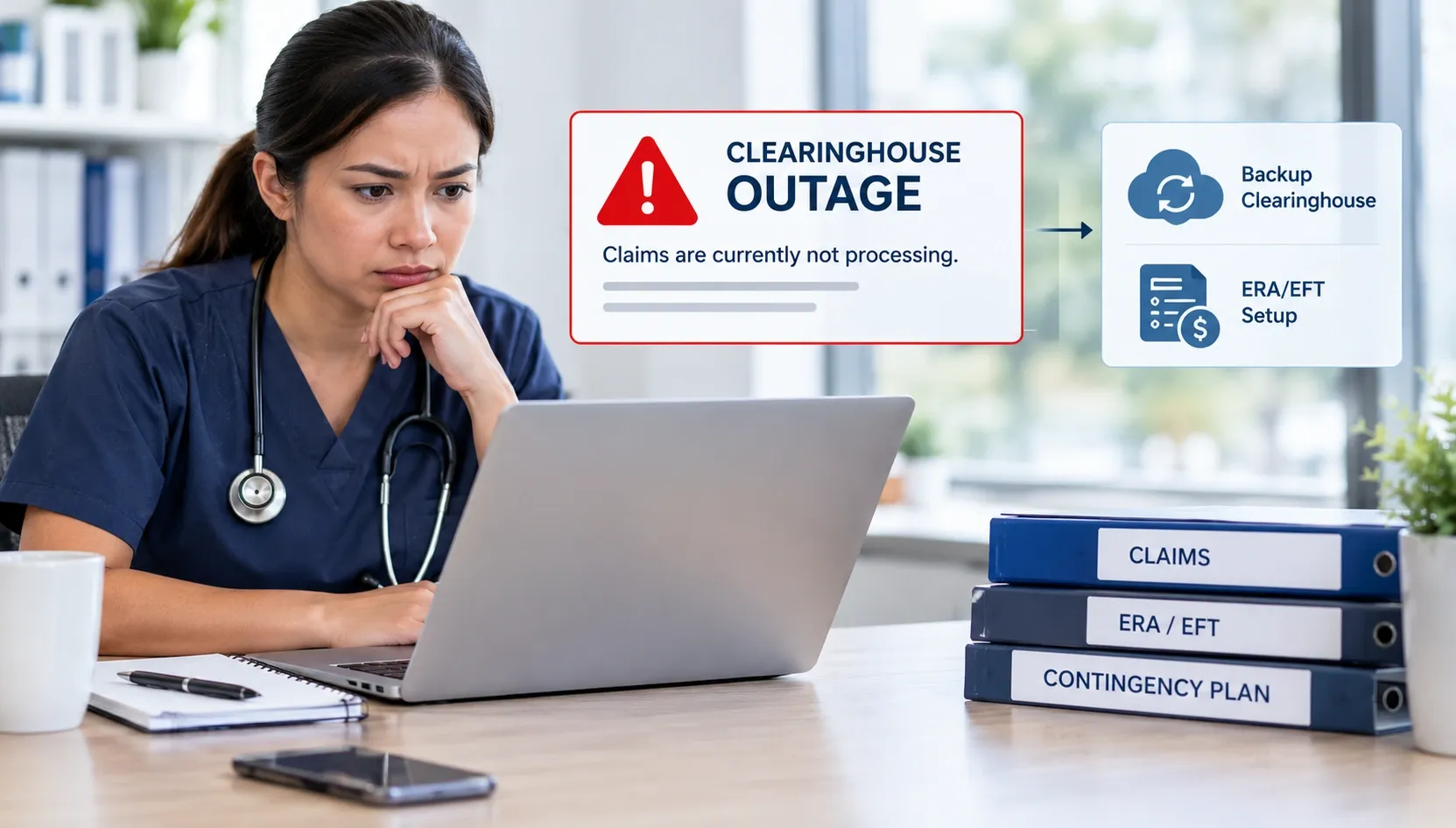
Most practices never think about their clearinghouse until it stops working. Then nothing goes out: no claims, no claim status, no remittances. Charges keep piling up, but the money doesn't follow.
Clearinghouse outages are rare, but they happen, and the 2024 cyberattack on Change Healthcare showed how widely one outage can spread. This guide explains what to prepare before an outage, what to do in the first 24 hours, and how to keep claims and cash moving until service returns.
What a Medical Billing Clearinghouse Does
A medical billing clearinghouse, sometimes called a healthcare claims clearinghouse, sits between your practice management or EHR system and insurance payers. It:
- Checks claims for missing or invalid data before they reach the payer.
- Converts and transmits claims in the standard electronic format payers accept, handling electronic claims transmission to each payer.
- Routes claims to the right payer.
- Returns responses, including rejections, claim status, and electronic remittance advice (ERA).
When it goes down, every one of those steps stops at once, which is why a clearinghouse outage feels bigger than most IT problems.
What the Change Healthcare Outage Taught Practices
In late February 2024, Change Healthcare, a subsidiary of UnitedHealth Group and one of the largest clearinghouses in the country, was hit by a ransomware attack. The HHS Office for Civil Rights described it as disrupting health care and billing systems nationwide. Change Healthcare later reported that about 192.7 million individuals were affected by the related data breach, according to HHS.
Practices that relied only on Change Healthcare couldn't submit claims or receive payments for weeks. The federal response showed what the main fallback options are. In March 2024, CMS directed Medicare Administrative Contractors to speed up requests from providers changing clearinghouses, to accept paper claims from providers who needed to use them, and to offer accelerated and advance payments.
The lesson for practices: many of the delays came from switching under pressure. Practices that had planned ahead recovered faster.
HIPAA Already Expects a Contingency Plan
A clearinghouse outage isn't only a billing problem. The HIPAA Security Rule requires covered entities to have a contingency plan for emergencies that damage systems holding patient data. That includes a data backup plan, a disaster recovery plan, and an emergency mode operation plan, with testing and review of those plans as addressable items.
A claims contingency plan fits naturally inside that broader plan. It covers the same goal: keeping critical operations running when a system you depend on goes down.
Before an Outage: 6 Steps to Prepare
- Map your claim flow. Document which systems, clearinghouses, and payer connections your practice uses, and which payers go through which route.
- Know your payer portals. List the major payers that accept direct claim submission or status checks through their own portals, and make sure staff have working logins.
- Decide on a backup clearinghouse. Choose one in advance, and find out what payer enrollment it needs. Enrollment can take days to weeks, so starting during an outage costs time.
- Document ERA and EFT setup. Record where each payer sends remittances and payments. ERA enrollment usually points to a specific clearinghouse, so it may need updating if you switch.
- Track timely filing limits. Keep a list of filing deadlines for your major payers. Medicare, for example, generally requires claims within one calendar year of the date of service, and commercial deadlines are often shorter.
- Write down roles and contacts. Name who declares an outage, who contacts the vendor, who works payer portals, and who updates leadership. Store the plan where staff can reach it if your systems are down.
During an Outage: The First 24 Hours
- Confirm the outage with the clearinghouse's status page or support line, so you know it isn't a local connection issue.
- Stop repeated resubmissions. Claims sent into a failing connection can create duplicates or confusion later.
- Start an outage log. Record every claim that can't be submitted, with the date of service, payer, and amount.
- Tell your team and your billing partner what's happening and which fallback you're likely to use.
- Check for security issues. If the outage is a cyberattack, follow your incident response plan and your IT provider's guidance before reconnecting anything. HHS's ASPR TRACIE cybersecurity incident checklist is a useful reference.
- Prioritize by dollars and deadlines. Decide which payers and claims need a workaround first.
During an Outage: Keeping Claims and Cash Moving
Submit Through Payer Portals
Many payers accept claims or allow claim status checks through their own provider portals. Portals take more staff time than batch submission, so use them for high-dollar claims and those closest to their filing deadlines.
Switch to a Backup Clearinghouse
If the outage will last more than a few days, a backup clearinghouse is usually the most efficient path. Expect payer enrollment steps, and update ERA enrollment so remittances follow the claims. During the Change Healthcare outage, CMS asked Medicare contractors to speed up these requests, but that kind of help isn't guaranteed in every outage.
Use Paper Claims Where Allowed
Paper claims are slow, but they're sometimes the only option. Medicare generally requires electronic medical claims submission, but CMS lists exceptions, including small providers and disruptions to electricity or communication outside the provider's control expected to last more than two business days. Check with your Medicare Administrative Contractor and each commercial payer before switching.
Protect Cash Flow
Estimate how long your practice can operate without payments, and act early if the outage may last longer:
- Ask payers about advance or interim payment options.
- Review your line of credit and upcoming expenses.
- Keep collecting patient balances at the time of service.
After Recovery: Catch Up and Reconcile
- Work the outage log and submit every held claim, starting with those closest to their filing deadlines.
- Watch for duplicates if claims went out through more than one route.
- Reconcile payments against claims, since remittances may arrive late, in batches, or through a different clearinghouse.
- Document proof of timely filing for any claim that went out late because of the outage. Some payers allow exceptions when you can show the delay was beyond your control.
- Review the plan. Note what worked, what didn't, and what to set up before the next outage.
How MBT Supports Your EMR/EHR and Clearinghouse Setup
A contingency plan depends on the details of your setup: which clearinghouse you use, how claims are routed, and where payers send remittances. That's the focus of the medical billing clearinghouse services from Medical Billing & Technology Partners (MBT), which cover clearinghouse enrollment, claims routing, ERA and EFT setup, and denial management workflows.
MBT works across a wide range of EMR/EHR systems used by healthcare practices, including:
- Epic
- eClinicalWorks
- GE Centricity
- athenahealth
- Experity
- NextGen Healthcare
- AdvancedMD
- Kareo (now Tebra)
- Valant
- DrChrono
Because MBT is powered by MotivIT, the same partner can also help with the IT side of an outage, from security questions to recovery planning. For more on that, see our healthcare cybersecurity checklist.
Frequently Asked Questions
What is a medical billing clearinghouse?
A medical billing clearinghouse is the service that sits between your practice management or EHR system and insurance payers. It checks claims for errors, converts them to the standard electronic format, sends them to the right payer, and returns rejections, claim status, and electronic remittance advice (ERA).
What should a practice do first if its clearinghouse goes down?
Confirm the outage with the vendor, stop resubmitting claims that fail, and start a log of every claim that can't go out. Then tell your team and your billing partner, check your other connections for anything unusual, and decide which fallback to use for your highest-dollar payers.
Can I submit paper claims to Medicare during a clearinghouse outage?
Sometimes. Medicare generally requires electronic claims, but CMS lists exceptions, including small providers and disruptions to electricity or communication outside the provider's control expected to last more than two business days. Check the CMS self-assessment and your Medicare Administrative Contractor's instructions before switching.
Should a practice have a backup clearinghouse?
For many practices, yes, or at least a documented plan for setting one up quickly. Payer enrollment for a new clearinghouse can take days to weeks, so practices that have done the paperwork in advance can switch much faster.
Do I need to re-enroll for ERA and EFT if I switch clearinghouses?
Usually for ERA, often not for EFT. ERA enrollment tells each payer where to send electronic remittances, so a new clearinghouse typically means updating it with each payer. EFT is set up between the payer and your bank, so it usually stays in place, but confirm with each payer.
This article is general information about billing practices and is not legal or compliance advice. Payer rules and regulations change, so confirm requirements with each payer and consult qualified advisors for your situation.
References
- HHS Office for Civil Rights, Letter on the Change Healthcare Cybersecurity Incident (March 13, 2024). hhs.gov
- HHS Office for Civil Rights, Change Healthcare Cybersecurity Incident Frequently Asked Questions. hhs.gov
- Centers for Medicare & Medicaid Services, CMS Statement on Continued Action to Respond to the Cyberattack on Change Healthcare (March 9, 2024). cms.gov
- Code of Federal Regulations, 45 CFR § 164.308, Administrative Safeguards. ecfr.gov
- Code of Federal Regulations, 42 CFR § 424.44, Time Limits for Filing Claims. ecfr.gov
- Centers for Medicare & Medicaid Services, Administrative Simplification Compliance Act Self Assessment. cms.gov
- HHS Administration for Strategic Preparedness and Response (ASPR TRACIE), Healthcare System Cybersecurity Incident Response Checklist. files.asprtracie.hhs.gov
About MBT
Medical Billing & Technology Partners (MBT) combines two established California companies. DMSCO Billing Services has handled medical billing, A/R management, and credentialing for healthcare practices since 1987. MotivIT is a San Jose–based managed IT provider that is SOC 2 Type II audited and supports HIPAA compliance, so its security controls have been independently reviewed. MotivIT also offers 24/7 support. Together, they give practices one partner for revenue cycle management and the technology behind it, with specialized expertise in California IPA billing and delegated financial responsibility.
Could your practice keep claims moving if your clearinghouse went down?
Our billing and IT team can walk through your clearinghouse setup and backup options.